TikTok SEO & SMO strategy: a must-have

Raquel Reis
Digital Marketing Strategist & Content Manager

That an SEO strategy is our great friend to optimize and position websites and blogs in Google, which we already know. And for social networks, is it relevant?

The data is not deceiving and the truth is that almost 40% of young people, when looking for a restaurant do not use the search option or Google Maps, but social networks such as Instagram and TikTok.

Raquel Reis
Digital Marketing Strategist & Content Manager

That an SEO strategy is our great friend to optimize and position websites and blogs in Google, which we already know. And for social networks, is it relevant?

The data is not deceiving and the truth is that almost 40% of young people, when looking for a restaurant do not use the search option or Google Maps, but social networks such as Instagram and TikTok.

These Google services are currently “threatened” by a growing preference for social networks as the first stop when searching, whether for a product, brand, or place.

Users nowadays search for information in a more immersive way through videos, forgetting a bit about searching by famous keywords.

It is becoming clear what we are getting at?

Digital is always changing and we cannot stand still. Social media managers know this; they are even realizing the importance of SEO in social media strategy and, of course, implementing it. According to the Global Social Media Trends Report, 89% say that social media search is important to their strategy.

If there were few doubts, now there are even fewer: optimizing content for social media search is no longer a nice-to-have, but a must-have.

What is an SEO strategy for TikTok?

Just as we do for web pages, this strategy is to optimize the videos on TikTok, through keywords, so that they come up first in search engines.

How important is SEO, if TikTok is not even a search engine?

Yes, it’s an entertainment social network and not a search engine, but users use it as such via the search bar on the platform itself.

TikTok has even been adding more options to improve video search: they have expanded the video description field from 300 characters to 2,200 and users can edit the subtitles (something previously impossible).

Also with the Google update that allows us to see TikToks in search results, we have been able to increase traffic to our accounts.
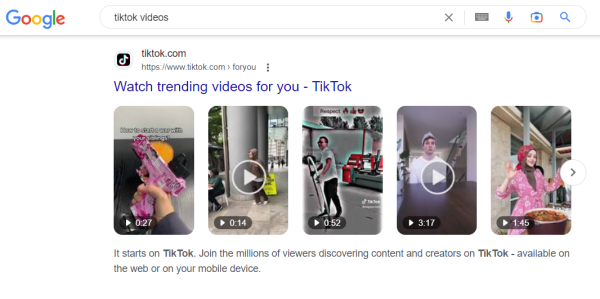
Source: Google search

What’s this SMO thing?

When we refer to optimizing content specifically for social networks the correct term is not SEO, but SMO – Social Media Optimization.

However, given Google’s new option that allows TikTok video search, it is possible to cross-reference the two – SEO & SMO -, and optimize content for both Google and the social network itself. The two strategies are allied and complementary.

There is no doubt that it is a great advantage to virtualize our videos and, consequently, reach more followers.

The way to implement a TikTok SEO & SMO strategy

Creating this strategy can seem like a difficult process and to help, we have simplified this process into 5 steps.

It all starts by understanding the audience and its research intent

As with any strategy, the foundation is to understand your audience and what they are looking for.

Start by analyzing the videos on TikTok that your followers are interacting with, what hashtags they are using, and the comments and messages they are leaving. By cross-referencing this data, you can identify their main interests.

Imagine you have a hair cosmetics brand and your goal is to attract an audience that is looking for the best shampoo products for their hair type. 

This audience may be looking for, for example, “best hair products”. To help you understand what the users’ search intent is you can use tools like AnswerThePublic and make a list of possible options.

Moving on to the next step…

Choosing the right keywords for the videos

We venture to call this step the core of SEO & SMO strategy: selecting the right keywords, the ones that will attract your audience.

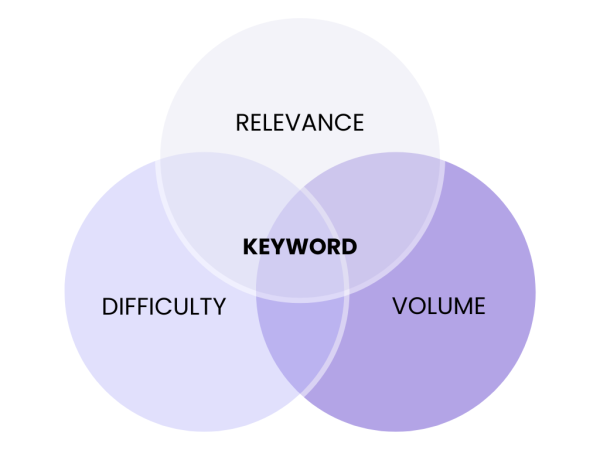
To select the best keywords you can follow 3 key SEO points:

  • Search volume – how many people are searching for the keyword
  • Relevance – how relevant is your content to the keyword being searched for
  • Keyword difficulty – the effort required to make your content rank well for a given search term
Several tools help you choose the best keywords such as Google Ads Keyword Planner, Semrush, Ahrefs, and Ubersuggest, among others. But these are essentially oriented to Google and not to TikTok.

As the implementation of an SEO strategy for TikTok is somewhat recent, there are currently no tools specifically geared toward this platform. But there is a great new feature: the Keywords Insights created by TikTok itself that helps inspire ad creation and may become a help for SMO. It’s worth a try!
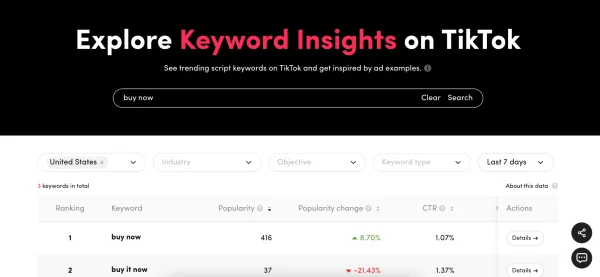
Source: Keywords Insights on TikTok
While we are testing this new tool, the ideal is to apply the search process as we exemplify below, imagining once again that we are a hair cosmetics brand:Source: TikTok search
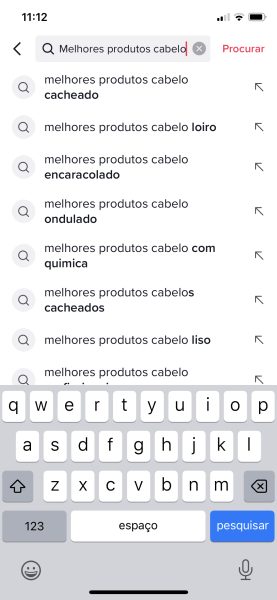
When we searched for “best hair products”, the platform itself provided several combinations of related keywords that users are interested in or actively search for: “best blonde hair products”, “…curly”, and “…straight”.

From this type of search, we were able to gather several relevant keywords for our strategy.

Embedding keywords in videos

Embedding the keywords in the video

We have reached the stage of including the keywords in the video. They should be added in the titles, descriptions, captions, and covers, and spoken aloud.

TikTok’s algorithm favors videos where the keywords are said. One tip is to mention them in the very first 3 seconds.

These should also be in hashtags so that, in a search phrase, our videos are more easily found by users. So, as in a Google SEO strategy, you can use the main keyword and variations of it.        

In short, there are five ways to incorporate keywords into TikTok videos:

  • In-video text
  • Speech
  • Caption
  • Hashtags
  • Automated closed captions

Ideally, you should put all these options together so that the video is optimized.

Determining a hashtags strategy

The phrase “the more the merrier” is not the best strategy when it comes to hashtags.

A good strategy involves having hashtags that match the content covered in the video and that combine long-tail keywords with short-tail ones. 

What makes them different? Long-tail keywords are more specific and have less search volume, but the conversion rate is higher. In a TikTok SEO & SMO strategy, we suggest using both types of keywords.
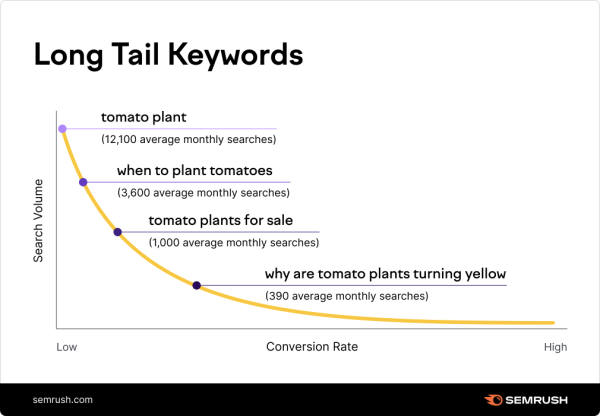
Fonte: Semrush


Again, using the hair cosmetics brand as an example… #bestblondehairproducts” is a hashtag using a long-tail keyword. The goal would be to reach an audience with an interest in knowing specific products for blonde hair. Using a short-tail like #hairsproducts, the goal is to reach the largest number of users with an interest in this topic in general.

Indexing is also a good way to use hashtags and drive series/short-tail discovery. For example, when creating a series of content about summer hair care, you could incorporate the hashtag #[account name]haircaresummer and thus group several videos that address this topic.

Analyze, learn, and review the strategy 

Last but not least important. It’s, in fact, one of the most important in any strategy: analyze data.

A TikTok SEO & SMO strategy is no exception.

Analyzing the videos’ data will give you insight into their performance. The algorithm takes into account the number of views, likes, and comments a video gets, as well as what other users are searching for.

If your videos have gone viral, you can reuse hashtags and create a second series on a particular topic or do A/B testing with similar hashtags.

Analyze, learn, and readjust. But if it goes well… repeat!


Now that you’ve reached the end, remember that more than ensuring relevance when creating content for the algorithm, optimizing it allows you to offer value and strengthen the relationship with your audience. 

We don’t communicate for algorithms, but for people.

Hybrid e-commerce: the end of exclusivity

Sandra Caravana
Copywriter

I bought some sneakers at a multi-brand sports site. How many kilometers will my sneakers travel to get to my house?

As a consumer (or shopper – for this text, we will put the two together), I traditionally go to a store and choose sneakers.

Sandra Caravana
Copywriter

I bought some sneakers at a multi-brand sports site. How many kilometers will my sneakers travel to get to my house?

As a consumer (or shopper – for this text, we will put the two together), I traditionally go to a store and choose sneakers.

Source: Pixabay

Why do I go to that store? Because of the price and the brands. And let’s leave aside the ‘white label’ discourse – it is discrediting for brands that have already established themselves in their niche. Take the case of Quechua. Scouts don’t buy Decathlon white brand tents, but Quechua tents.

Sneakers chosen – tried on with more or less originality by the store – and proceed to the checkout. They are ready to wear.

If you buy the sneakers online, I don’t have the consumer experience – putting the sneakers on before you buy them and talking to a salesperson who also wears the same sneakers. But as a general rule, there are more options online. Physical stores have limited space (no matter how big they are) and that’s why you make range choices.

I know from buying online that I have to wait for the sneakers to make the trip from the store (or warehouse/factory) to my home. And if I’m not home at the time of delivery, the sneakers make one more trip to some warehouse, where I have to pick them up. No problem, what matters is that the sneakers arrived.

The challenge for today is to put ourselves in the shoe’s shoes.

What is the big dilemma? Sneakers don’t choose their route. They want to go home – the final consumer – but until then, they can have several homes. Or temporary foster families, is this the correct term?

The H brand and SUPER sneakers

I represent the brand H (let’s be inclusive and stop always using X or Y). We created some sneakers that, besides the futuristic design, have a technology that allows the foot to breathe, preventing the user from getting sweaty feet at the end of the day. We even baptized this model: SUPER.

SUPER sneakers are manufactured (we will not go into details here about where in the world) and are shipped to wherever we want. This choice is related to the business model chosen by my company.

We will speak here of the business model in the sense of the purchase/sale transaction.

Fonte: Pixabay

A brief introduction to business models

The acronyms in this part of the sales business are intuitive, but take note:

  • B2C (business to consumer): Classic. Direct sale. The business relationship occurs between the company and the final consumer (or shopper) and involves no third-party action. 
  • B2B (business to business | from company to company): The consumer relationship is between companies, not involving the end consumer. The sale/purchase has the purpose of supplying a need of the company – which may or may not reach the end consumer. 
  • B2E (business to employee): occurs when the company provides discounts or forms of payment that are not applied to the market. This way, employees can buy the products/services of the company they work for in a differentiated way.
  • B2G (business to government): is the business relationship between companies that sell, or provide services, to the government – either to municipalities or at a national level. These are companies with a track record of responding to public tenders. This model need not be exclusive.
  • B2I (business to investor): the business relationship takes place between the company and the future investor and works as an accountability, where the company that is selling presents its projects, data, and information. Widely used in the real estate industry.
  • D2C (direct-to-consumer): is a business model that resembles B2C. Here the difference is in the source of the product – instead of a company selling, the marketing is done directly by the manufacturing industry. It is easy to identify with the ‘factory price’ label.
  • B2B2C (business to business to consumer)

… Well, we get it.

So where are the SUPER going?

The choice of a B2B or B2C model is closely linked to the storytelling of the product, its marketing strategy, and the way the brand decides to communicate with the shopper and the final consumer.

I want to manufacture SUPER and sell directly to the final consumer: it means quick sales. The brand is talking to those who use the product. It follows the more traditional model and opens a physical and online store, with its brand name: H. It will be present in malls and traditional commerce – OR exclusively in one of them. This choice is related to the persona created/chosen by the brand (the ideal consumer).

When we choose a B2C, the most common thing is not to have the financial fit to have a store/warehouse, a large space with aisles, and more aisles of products lined up and organized by price. Better known as retail.

These stores/warehouses are built from scratch (preferably) by B2B business models – WARNING: this is not that taxing, but it is the most common. For this example, we are talking about such multi-brand stores: the MM store sells sneakers of its brand, but also of other brands, for which it has no influence on the construction of the product or its history. The MM store can, if the H brand so allows, insert SUPER sneakers in its range and sell them in-store. But the decision is on brand H’s side: B2C, B2B, or D2C.

In the digital world, the choice of business also differs.

There are many decisions to be made:

  • Do we sell exclusively on our site?
  • Do we sell exclusively on the site of multi-brand stores?
  • Do we sell both?
  • Do we sell both, at different prices? – Yes, the law of the market allows it, because…

… the price of the product also depends on the journey it takes.

What is the great advantage of selling online?

Besides increasing the volume of business?

We know who buys our product (shopper) and we know who uses our product (consumer). Buying and using are different things. The best example is toy stores. Who buys? Adults. Who uses? The children. So here we have two audiences to analyze.

We want to know everything, EVERYTHING, about them. Everything is recorded, like history, like the digital footprint. Wonders of e-commerce.

ONLY THAT…

… if I only sell the SUPER ones in multi-brand stores, I don’t know who my final consumer is. I give up this data. But that data is what enables us to have products that meet the needs and interests of the customers.

Choices, choices, choices.

Source: Pixabay

In B2C, the sales process is focused on the individual needs of the customer, and the sales cycle is short, with a large (or medium) emotional component.

In B2B, we expand our cycle.

Do we have to choose one of the models?

Yes and no. In typical Portuguese, it depends.

But we can have a hybrid business model.

A hybrid model allows you to bring together, on a single platform, the entire digital structure: customer databases, product information, content, graphic arts, pricing, profit margins… well, all the information you want to cross-reference. So the hybrid model has a single e-commerce platform. And who will analyze this data, will also be a single team – a reinforced team, of course. Because here, the data analysis work requires creating and analyzing multiple customer profiles.

All this for the better…

… business optimization. Obvious. Everything is in a single system, even marketing strategy. Strategies. Plural. For the same product, we can have different images and canopies, depending on the location of the sale.

This hybrid model will have an advantage over your competitors: you can create customized products and different marketing strategies for shoppers and consumers.

Source: Business Webstars

What about merchandising?

Ah, who doesn’t love an offer of a tote bag, a pen… a notepad!

Businesses whose commercial exchanges are exclusively B2B do not invest much in merchandising. It makes sense: why invest if we are not selling directly to the consumer? They can, and usually do build a layout for their product at the point of sale. A good example of this is the huge and colorful furniture full of cookies, also full of sugar, in small grocery stores. There is no brand store for these cookies, but the brand invests in creating displays that are compatible with the small business that sells these cookies.

Already in a hybrid business, merchandising is important and everything is chosen and described on that one platform, with a well-defined budget.

In conclusion:

A hybrid business model is a crossover. Yes, like when the characters from Grey’s Anatomy take a trip to the world of Station 19. This analogy makes perfect sense: in the first episode of Grey’s Anatomy, there were no streaming platforms. We had to wait for RTP2 to buy the series and we were only allowed to watch one episode a week. Today, we can watch Grey’s Anatomy online, on our pc, tablet, and smart. It is the natural evolution of things to the digital world.

The key phrase of this hybrid model is EXPAND: more customers, a bigger database, and a bigger business volume. And on the other hand, SAVE is a single e-commerce platform.

It’s all a bed of roses. But it isn’t.

These are choices, above all.

By changing your business, customers will be more demanding.

Let’s talk about Nespresso. What else?

Nespresso has been among the most profitable projects at Nestlé with steady growth for two decades, although the beginning of its history dates back to 1970. You can read more about this long journey here

Nespresso arrives in Portugal with a physical store in Chiado, Lisbon in 2003. Not store – Boutique. So, I, who am from Coimbra, had to go to Lisbon to buy the machine and the coffee capsules. No. The website had that option. Mainly for the capsules. In 2007, they decide to open a new boutique in Norteshopping. The brand is no longer only in prime locations, but also in shopping centers. In 2009, they opened a new boutique in Porto, and from then on these boutiques – small stores where the capsules are displayed for sale and consumption, in a customer experience logic – became the norm. But until we reached this point, the Nespresso consumer in Coimbra had to buy the coffee capsules directly from the Nespresso website. Why? Because Nespresso doesn’t sell on large commercial surfaces, it doesn’t sell to small businesses or the retail trade.

In 2022, Nespresso still doesn’t sell the capsules for other commercial surfaces to sell, but the Nespresso brand coffee machines are within our reach in any home appliance store.

It is indeed an interesting example that shows different choices, without exclusivity.

Will we live to see Nespresso coffee capsules for sale in big supermarket chains? The red one? Or that green one… Baby steps, without ever escaping the original concept of the brand.

Fonte: Pixabay

What about Nike? Nike has moved to the hybrid option: we can buy on Nike’s website, in Nike’s stores, and multi-brand stores. And at the multi-brand stores’ websites.

So Nespresso’s preferred commercial exchange is D2C: direct to client. Nike is B2B, D2C, B2C.

In a D2C, my SUPER sneakers may even have a lower price, because they don’t have many miles to go. But if brand H decides to sell to retail as well, it has the right to increase its value, because there is more logistics work. To match the value, the multi-brand store has to lower its profit margin. Easy math to do.

For this hybrid model, we have decided to give an acronym name: B2E – business to everyone.

Does it make more sense? Or is it too populist for the business world?

We won’t end this article without mentioning C2C – client to client. Yes, we can also sell our Nespresso machine on the OLX of this life. The internet made e-commerce possible and social networks developed C2C. And here, there are no taxes, no fees, no legislation, and no control of the exchanges.

KPIs that measure the success of brands

Pauliny Zito
Planner, copywriter and copydesk

Key Performance Indicators or KPIs are a very common way of measuring how a company is growing as a whole. 

KPIs are intrinsically linked to business goals and aspects of the business, usually defined and reviewed every quarter. They help track the health of the business, which is why they are also called health metrics.

Relevant KPIs that measure the success of brands are result indicators, not simply activity meters.

As Noelia Fernandez, Google’s Director of Large Customer Sales for Northern Europe rightly said: “Ultimately, success is proven when behaviors have changed.

Pauliny Zito
Planner, copywriter and copydesk

Key Performance Indicators or KPIs are a very common way of measuring how a company is growing as a whole. 

KPIs are intrinsically linked to business goals and aspects of the business, usually defined and reviewed every quarter. They help track the health of the business, which is why they are also called health metrics.

Relevant KPIs that measure the success of brands are result indicators, not simply activity meters.

As Noelia Fernandez, Google’s Director of Large Customer Sales for Northern Europe rightly said: “Ultimately, success is proven when behaviors have changed.

Source: Fauxels

How to define KPIs 

When starting the process of defining KPIs, the professional should ask himself:

  • What information do I wish to obtain? 
  • What is the desired outcome and why is it important?
  • Who is responsible for the result?
  • How will I achieve the result?
  • How often will the goal and progress be re-evaluated?
  • How will I measure success?
  • It is critical to align the indicators according to the business objectives.

A good KPI has certain basic characteristics: it is available to be measured; it is important and relevant to the basis of the business; it helps in making smart choices, and it has periodicity, i.e., it needs to be tracked and measured constantly.

In short, a good KPI shows how your goal is bringing more business or business opportunities to your company.

KPIs for brands

During the process of analyzing your brand, you should consider buying behavior and information, advertising and touchpoints, brand promises and associations, brand digitality, and their individual questions.

For a brand to succeed, it is crucial to know the needs and wants of consumers, and your target audience, have a broad view of the market and competition and understand how your brand can become more relevant and attractive over time.

The main types of KPIs are sales, marketing, and productivity, and their main categories are:

  • Productivity indicators

They measure the number of resources the company uses to generate a given product and/or service.

  • Quality indicators

Help analyze the quality of the product and/or service throughout the production process.

  • Capacity indicators 

Analyze the response capacity of a process through the relationship between outputs produced per unit of time.

  • Strategic Indicators

They provide a comparison of the company’s current scenario concerning previously defined goals.

KPIs can also be classified into three basic categories:

1. Primary KPIs

These are the primary ones for your objective, namely: leads (potential customers), traffic, acquisition cost per lead, conversion rate, total revenue, and revenue per purchase, among others.

2. Secondary KPIs

They show that the testing and management of the strategy are going well. Secondary KPIs should justify the primary ones, showing how those results are being achieved. Some examples: cost per lead at each stage of the funnel, newsletter subscribers, blog subscribers, recurring blog visits, cost per visitor, traffic origin (organic, paid, social media, direct, email, and others), and average price per transaction.

3. Practical KPIs 

Page views and visits, bounce rate, best landing pages, page rank, most searched keywords (according to your business), most read/visited content, traffic, visitors (new vs. recurring), and social interactions.

The Marketing manager should periodically evaluate all the chosen KPIs, however, the most interesting KPIs for the management are the ones that bring financial gains to the company.

KPIs versus metrics

KPIs and metrics are not the same things. While KPIs are indicators of company performance, a metric is just something to be quantified or measured, which generates reports and insights. 

However, a metric can become a KPI when it helps with internal company decisions and/or guides the company in its purposes since to be a KPI, it has to be valuable to the business and help managers make smart decisions.

Always keep in mind that the KPI must be relevant to the purpose. Vanity indicators, that is, indicators that do not show any results, are not good KPIs, such as, for example, the number of followers and amount of likes on Instagram.

KPIs that measure the success of brands

There are thousands of KPIs, which can be numbers or percentages, and the challenge is to figure out which ones are most important for your business while also taking into account your company’s industry or sector.

Source: Vlada Karpovich

Quantity of Leads

Lead is a business opportunity, that is, a person interested in the product or service, or a potential customer. To attract visitors and convince them to leave the contact, you need a strategic and focused Inbound Marketing campaign. This indicator is relevant for both the Sales team and the Marketing team, just identify the total number of leads generated in the business in a given period.

Quantity of Prospects

Prospect is a lead in a more advanced stage, almost ready to purchase the product. When a lead evolves into a prospect, the Sales team will understand the best moment to approach it, how to do it, and which offers are more interesting for this future consumer.

Cost per Lead (CPL)

The CPL is the cost to generate a lead. It is necessary to measure each channel and acquisition method to understand which one generates more leads and its respective cost, and thus optimize investments and increase lead generation. Formula to calculate the CPL: total cost of marketing actions ÷ number of leads generated in a given period.

Customer Acquisition Cost (CAC)

The CAC is related to both Marketing and Finance. It is the company’s average expenditure for the acquisition of a customer. It can be calculated using the formula: total sales and marketing expenses ÷ total customers acquired.

Cost per Click (CPC)

The CPC is the cost determined by online advertising platforms for each click on a sponsored ad. It is the actual amount the advertiser will pay for the click on your ad. Calculation: total campaign cost ÷ number of clicks the ad received.

Churns Rate

The churn rate is the total amount of cancellations, i.e. how much revenue or customers the company lost. Calculation: the number of customers lost ÷ total active customers at the start of the analysis period × 100.

Lead Conversion Rate

It is the percentage of leads that became customers, in other words, generated leads versus converted leads, very useful for analyzing the performance of the Digital Marketing strategy, calculated using the formula: total leads ÷ total visitors × 100.

Click Through Rate (CTR)

The CTR is one of the most important indicators to be monitored in a Digital Marketing strategy. It is the click-through rate of an email or ad, which indicates the percentage of people who clicked on the link after viewing it. It is calculated using the following formula: number of clicks the ad received ÷ total times the ad was displayed × 100.

Customer Retention Rate 

The customer retention rate is the number of customers who remain loyal to the company after conversion or purchase. The longer you keep a customer, the greater their lifetime value. 

Monthly Qualified Leads

Some factors can show when the leads are ready, that is, qualified for the Sales team to act: the need the lead demonstrates for the solution; the match between the product and the lead (geographical factors, availability, etc.); the budget of the lead’s organization (purchasing power); the authority of the contract (decision-making power); the timing of the sale and the interest.

Average ticket

The average ticket is the average of how much each customer spends with the company, a great metric to evaluate sales performance. The calculation of the average ticket is the sales volume in the period divided by the number of sales in the same period.

Revenue 

Revenue represents the capital inflows that result from a company’s activity when selling products or services: quantity of products or services sold × price.

ROI (Return on Investment)

ROI (return on investment) is the amount billed subtracted from the costs, divided by those costs.

Traffic 

Several visits to the website, can be measured and tracked daily or monthly: DAU (Daily Active Users) and MAU (Monthly Active Users). The traffic shows whether email, SEO, and social media efforts are generating good results, and indicates the best performing channels (traffic origin) and keywords in the campaign.

Returning Visitors/Total Visitors

Of the total website visitors, how many returned?

Average time on page

Average session length of visitors to the website or blog.

Website Conversion Rate

Of the total visitors, how many of them convert an action, namely: download an e-book, make a purchase, fill out a form? It is the conversion of website visitors into leads, whether qualified for Marketing or Sales.

The conversion rate of a CTA

Of the visitors to a page, how many of them click on a button (CTA: Call to Action)?

Click through rate on pages 

Of the visitors to a page, what percentage of them click on some link?

Pages per visit

How many pages are viewed per visit to the website or blog?

Amount of backlinks 

How many links on other (relevant) websites direct to your website?

Page Authority

Page authority is the measure of content quality and page relevance provided by analytical tools.

Google Pagerank

Page ranking on Google, calculated by Google from the use of various algorithms to determine the importance of pages.

Keywords in the TOP 10 SERP

Several keywords on the website cause it to be displayed among Google’s top 10 results.

Conversion Rate by Keyword 

Percentage of visitors attracted by the keyword that converted actions on the website.

Bounce Rate

Of the visitors to the website, how many of them access a page and after a few seconds left?

Traffic generated from social networks

Visitors to the website came from links on social networks.

Cost per Thousand (CPM)

CPM in digital marketing is an acronym for the performance metric “Cost per Thousand Impressions”, that is, what amount is being charged when ads are printed (displayed) a thousand times.

Click to Open (CTO)

The CTO is the number of clicks divided by the number of emails opened.

Social Engagement

Involvement of people with the brand through shares, comments, and mentions on social networks.

Net Promoter Score (NPS)

The NPS measures customer satisfaction. It asks “from 0 to 10, how much would you refer our company to friends?” The formula for calculating NPS is the percentage of promoting customers (scores of 9 and 10) minus the percentage of detracting customers (scores of 0 to 6).

Customer Lifetime Value (CLTV)

CLTV is the prediction of the total amount of money a customer will spend during their relationship with the brand, i.e. the value a customer generates for a company over their lifecycle.

Sales Cycle Time

The time it takes to complete a sale.

Average Sales Conversion Time

The time, on average, that the Sales team takes to convert a sale

Customer Growth Rate

The percentage of customer growth from one month to the next, each quarter, semester, or year.

Brand Equity

Brand Equity is the set of associations and behaviors on the part of customers, channel members, and the brand’s parent company that allows the brand to earn greater volume or higher margins than it could without the brand name, and that gives it a strong, sustainable, and differentiated advantage over its competitors. (Source: Marketing Science Institute)

Brand value is the strength of a brand from the financial assets involved in it. An intangible differentiating effect, which, if positive, gives it a competitive advantage in the marketplace. Brand value can be determined from the financial results of a product about its prices; the brand value when introducing new products; and the brand value based on the thoughts, sensations, and habits of customers about the business.

In this context, the following variables also contribute to the success of a brand, making it valuable: Brand Knowledge, Brand Remembrance, Brand Image, Brand Recognition, and Brand Coherence, in addition to Brand Satisfaction.

Brand Knowledge is the level of familiarity of consumers with the product or service and the key to Brand Equity as it generates a differentiated response, and can be characterized into two components: Brand Remembrance and Brand Image.

Brand Remembrance is the ability of consumers to remember the brand unaided. Brand Image is how consumers see the brand, how they perceive what it represents, the associations they make with the brand and their feelings after interactions with the brand.

Brands with high Recognition are seen as trendy, popular, and prominent.

Consumer Satisfaction with a particular brand is a consequence of the feelings and thoughts regarding their experience with the brand and is directly linked to Brand Consistency, that is, the difference between the promises of the brand and the actual perception of it.

A satisfied customer can become an advocate for the brand, referring it to others.

Data-driven Marketing and Sales

Data-driven is a strategy of collecting, storing, and processing data, to generate insights, trends, and information about the business itself and the market. The management of this data helps transform knowledge into smarter actions and decisions

The company’s Marketing and Sales departments must analyze the data intelligently and make the best decisions. To do so, they must do some initial planning to identify all the conversion points.

The most important KPIs for those analyzing the data are:

  • Click Through Rate (CTR) = click-through rate of an ad/email;
  • Connect Rate = connectivity rate, which indicates how many clicks became sessions;
  • Conversion Rates in the Marketing funnel: Visitors → Leads → Opportunities → Customers;
  • Cost Per Lead (CPL);
  • Customer Acquisition Cost (CAC).
Source: olia danilevich

Teams should also check whether the audience is accessing the website by mobile or laptop; what the conversion performance is by each browser type; and whether there is one channel that brings in more than 50% of the results.

Other relevant indicators are:

  • Average Session Time on the website and Rejection Rate;
  • Connection time with a server;
  • SEO (Search Engine Optimization): evaluate traffic and integration with Google Search Console to compare results by period and identify specific keywords used to reach each content.

Regarding the Sales team, the five main KPIs to be looked at are:

  • Customer Lifetime Value (CLTV); 
  • Conversion Rates: from what enters the funnel to what leaves it;
  • Percentage of the team that is reaching the target;
  • Number of sales per salesperson;
  • Sales pipeline movement.

Strengthen your brand through KPIs

KPIs make it possible to track and better manage the level of performance and success of the company’s strategies because they monitor the company’s health, measure progress, analyze patterns over time, and help the manager to make adjustments and stay on track, solve problems, and seize opportunities.

Thus, KPIs provide a diagnosis of the company, so that it can act on the problem and better position itself in the market.

Advantages of a strong brand: 

✔ Better perception of product or service performance;
✔ Greater loyalty;
✔ Less vulnerability to competitor marketing actions;
✔ Less vulnerability to crises;
✔ Higher margins;
✔ More inelastic consumer response to price increases;
✔ More elastic consumer response to price reductions;
✔ Greater cooperation of intermediaries;
✔ Greater effectiveness of communication and marketing programs;
✔ Licensing opportunities;
✔ Brand extension opportunities.

Strengthening brand value will only be possible by first understanding the audience’s behavior well, then measuring relevant KPIs and making recommendations for actions derived from them.

How to create an audience through copy

Pauliny Zito
Planner, copywriter and copydesk

Copy is not “just” for blog articles, websites or social media captions.

The fact is, with social media, we’ve started writing a lot more and we’ve all become “writers” or “copywriters” as you will.

Writing will always be part of the process, whether creating videos, podcasts, dynamic presentations or games. After all, planning is necessary.

No matter the format or medium, the challenge is to write so well in order to create a loyal audience throughout the buying journey.

Understand how in this article.

Pauliny Zito
Planner, copywriter and copydesk

Copy is not “just” for blog articles, websites or social media captions.

The fact is, with social media, we’ve started writing a lot more and we’ve all become “writers” or “copywriters” as you will.

Writing will always be part of the process, whether creating videos, podcasts, dynamic presentations or games. After all, planning is necessary.

No matter the format or medium, the challenge is to write so well in order to create a loyal audience throughout the buying journey.

Understand how in this article.

What is copy?

Copywriting or simply Copy is persuasive writing, a technique to convince the audience to perform an action.

Therefore, copy, whether conversion or content, is totally linked to a persona (representation of the ideal customer).

A good copy…

Is never a copy of another.

Does not generalize. 

Is not aggressive.

Doesn’t use clichés.

A good copy is creative and always original, aligned with the digital marketing strategy and aimed at the persona.

A good copy contextualizes and has a certain depth.

Inbound Methodology

For a successful copy, apply the Inbound Methodology.

Inbound = Content + Context (for those who are creating it).

Simply put, it’s the right information to the right person at the right time, across all interactions.

Inbound Marketing works to create individualized relationships that make a lasting impact on your audience and your brand. In other words, the focus is always on the customer.

This methodology should span all teams (Marketing, Sales and Service) and basically has three phases:


  1. Attract (Attract)
  2. Engage
  3. Delight
  4. Some authors identify these three phases like this:
  5. Attraction
  6. Consideration 
  7. Decision

Storytelling

Some people like to tell stories. Some people like to listen to stories. But of one thing we are sure. A good story is capable of catching the attention and captivating many people.

For this reason, the storytelling method is very present in the production of content in general. And, of course, also in copywriting.

Stories connect people with people, generate identification, and for this reason it is an excellent strategy to bring brands and customers closer together.

Engage the persona when relating your story. Identification happens depending on the situation, the journey and the emotion.

Furthermore, storytelling is a good technique for possible viralization, and can be applied punctually in the content or as part of its structure.

Hero’s Journey

  • Introduction
  • Problem (Pain)
  • Refusal to call (moment of tension)
  • Mentor
  • Challenge (Climax)
  • Resolution
Source: yogesh more, Pixabay

Mental triggers

Mental triggers are psychological motivators or facilitators for the brain that help arouse emotion, and are widely applied in copy.

Robert B. Cialdini, in The Weapons of Persuasion, mentions six triggers most commonly used in advertising:

1) Reciprocity

Reciprocity is delivering value so that the persona reciprocates.

2) Commitment and Coherence

Keeping to the agreement and being consistent at all times.

3) Social Approval

“Since 95% of people are imitators and only 5% initiators, they are convinced more by the actions of others than by any evidence we can offer.”

– Roberto Cavett

4) Affection

Affection is about creating a bond, connection with the persona.

5) Authority

The company as an expert in a particular subject. It is the principle of reputation.

6) Scarcity

Scarcity can be of time, bonuses, vacancies, access.

How to make your writing easier, more accessible and fun 

There is a method called the Writing GPS Framework that puts the reader at the centre of your work and enables you to publish with confidence.

It takes the writer or copywriter from an initial idea to a complete piece of content.

The GPS Structure of Writing has three stages:

1) G: to go (Go)

Before you actually start writing, the first step is to research and plan, because then the writing should flow more easily and naturally.

But before that, identify your goal, that is, the aim of the content. Look at that goal and reframe it from the customer’s perspective, thinking about the benefit to them and why they should convert after reading your content.

Then gather data or evidence, such as statistics, facts, figures, research, quotes from experts, testimonials from other customers.

Finally, organize your ideas, thinking about the format of your content.

2) P: to push (Push)

It’s time to write and rewrite.

First, write a first draft without worrying about mistakes or inconsistencies, because the point here is to get your ideas down on paper. 

Next, rewrite your content for one person (the persona, for example), keeping the good parts, eliminating the bad parts and rewriting the content. By doing this, your writing will have a more natural, focused, friendly and accessible tone.

With time, and some techniques, you will develop your own voice, winning over your audience: notice what repeats in your content, the length of your sentences, your vocabulary, your punctuation, your descriptive style, your differentiation from other writers. 

An extra tip is to always test new styles and new ideas, especially techniques from people you admire.

3) S: to Shine

In this last stage, you should revise the content and publish it.

For this, you can resort to Artificial Intelligence editing tools, such as the Grammarly or Hemingway apps. But beware! AI should not replace a good human editor or proofreader. 

Finally, read your content aloud to identify where/if it is confusing, in addition to the flow and rhythm of the writing.

Ask yourself: does this content make the reader want to move on to the end?

How to create a long-term content plan

To create an audience through copy, you will necessarily have to create a long-term content plan. 

How to do this? Consider the following three steps:

Step 1: Set marketing goals

Set marketing goals based on SMART Goal: Specific, Measurable, Attainable, Relevant, Timely.

Step 2: Assess your organisation’s initiatives and assets

Assess your organisation’s initiatives and assets through content audit, event-based audit, such as projects, priorities or upcoming events.

Step 3: Identify the customer journey for your buyer personas

In this step, remember that the customer journey is always evolving.

How to use copywriting 

Copy in the stages of the funnel

  • Top of the Funnel: Discovery

At the top of the funnel, a mental trigger that works well is Reciprocity. At this stage, offer rich content to your audience.

  • Middle of the Funnel: Solution

In the middle of the funnel, use the mental triggers Social Proof and Storytelling in order to strengthen the relationship with your persona.

  • Bottom of Funnel: Decision Making

At the bottom of the funnel, work with the mental triggers Authority and Scarcity using persuasion.

Copy in rich materials

Use timeless language in your rich material.

Explore comparisons. 

Put yourself as a reference, an authority, and present something relevant, with a differential.

Write persuasive titles, with questions or promises – and deliver on them in the rich material (in the e-book, for example).

And don’t forget to interact with the persona.

Copy in conversions (sales)

Get the persona’s attention. 

Explore their pain. Present the solution. Arouse emotion through mental triggers. 

Show the path to decision making. 

Write an impactful sentence and a call to action (CTA) that is clear and direct, but not crude, however with short and simple sentences (5 to 7 words).

Scannability

Scannability is the same as optimizing content to improve the user experience, i.e. a feature to make the content easier to read dynamically.

Such resources can be:

  • bold
  • italics
  • intertitles
  • numbered lists
  • images 
  • links

A search engine optimised copy uses:

  • keyword assertive
  • authentic content
  • quality text
  • SEO-friendly copywriting

How to create an irresistible copy

If you’ve made it this far, congratulations! 

You’re really committed to creating irresistible copy!

Techniques

Below, I share some techniques to consider in your copy:

3 Cs

Clear | Concise | Compelling

1-2-3-4 Formula

What’s in it for you? Write all about the offer, product or service.

What will I do for you? Write about the advantages and benefits of the product or service.

Who am I? Demonstrate Authority. Write about your company (or yourself for that matter).

What are the Next Steps? Place the CTA.

Formula PAS

Pain | Stir | Solve

4 Ps of Persuasion

Promise | Image | Proof | Push

Writing Tone

However, for a copy to be, indeed, irresistible, combine these techniques with an important key element: the tone of the writing.

Just as important as what you say (or write) is the tone you choose to say (or write) it. Ultimately, it is your mode of expression. 

In this way, the tone of your writing is obtained by the choice of words, the story told and the intended connotation. 

Too much irony, too few resources compromises your writing and can make your audience abandon your content. And worse, give up on the purchase, if the copy is converting.

A good, effective and memorable story will not always be a guaranteed success, because it depends on how it is told. And that ‘how’ will depend on ‘who’ is listening (or reading).

Just as far-fetched or very technical words can drive away the audience because they consider them elitist.

Did you understand why the persona matters so much?!

The Soul of the Copy

A successful copy is one that interacts with the persona and touches on their emotions. 

A successful copy is one that employs a tone in the writing that connects with the persona.

Show your audience the benefits of what you are selling. 

Move it, induce it, lead it towards a solution.

Help your customers to grow. 

Create lasting relationships through three strands:

  1. Solving problems.
  2. Helping them achieve goals.
  3. Exceeding expectations, with additional recommendations, instruction and high-level service.

I close this article with some tips for you to write a soulful copy: 

✔ Put yourself in the shoes of your buyer persona.

✔ Monitor social media to see what your customers have been saying about your brand.

✔ Measure and track interactions.

✔ Conduct surveys with your customers.

✔ Ask open-ended questions.

✔ Benefit from the 80/20 Rule: 80% listening | 20% speaking

✔ Have reciprocity.

✔ Use data and research.

✔ Establish constant interactions (big or small).

✔ Write variations of the same copy.

And remember, the companies that educate best will be the most successful.

A Little Guide to Time Management for Freelancers

gestão-de-tempo-para-freelancers
Sandra Caravana
Copywriter

Do freelancers need a biometric time clock?

The myth of the freelancer: it is a lifestyle in which the person who chooses to follow it has no hours for anything. Legend has it that so-called freelancers decide their own hours. It is the exponent of freedom. We can distinguish a freelancer from ordinary mortals in the bank queue: he is the one who is there at 11:43 in the morning and is not stressed. Or at the family doctor.

Is it really like that?

Sandra Caravana
Copywriter

Do freelancers need a biometric time clock?

The myth of the freelancer: it is a lifestyle in which the person who chooses to follow it has no hours for anything. Legend has it that so-called freelancers decide their own hours. It is the exponent of freedom. We can distinguish a freelancer from ordinary mortals in the bank queue: he is the one who is there at 11:43 in the morning and is not stressed. Or at the family doctor.

Is it really like that?

A freelancer is an autonomous, independent professional – but should not be confused with the accounting concept of self-employed. As a rule, a freelancer works on a project basis. A text, a song, a translation, a design… and gets paid for that work. These are mostly professions that do not require the professional to be routinely present at a specific site. Freelancers can be digital nomads, although there is not necessarily reciprocity.

So, is a freelancer totally free?

If a freelancer works on a project basis, why is time management so important?

With great power comes great responsibility – as Uncle Ben used to say.

Strawberry Nevill exposes time as a unit of energy.

Let’s take the example of a copywriter for social networks. The job is to write a 200-word post to announce the new menu of the restaurant The Fictitious Restaurant. The logical thing would be for this copywriter to monitor how much time he needs to write such a post and, from there, manage his schedule by work periods. Nevill proposes looking at schedule management as units of energy. This notion of energy is associated with the concept of concentration.


We do not have the same level of concentration, or attention span, throughout our lives. It has been estimated that 2-year-olds tend to concentrate 4 to 10 minutes on an activity; 7-year-olds about 14 to 35 minutes, and 10-year-olds for 20 to 50 minutes. These studies must be presented with relative precision, as there are many influential aspects regarding our attention span other than age. To see the work per unit of energy, we must realize what our attention span is, but it will not be a primary factor.


Time passes faster when we do something we enjoy, as the other said.

Source: Pixabay

Let’s take the example of a designer whose project is to create a logo for the restaurant The Fictitious Restaurant. How much time does a designer spend designing a logo? It takes time to meet with the client, it takes time to meet with the marketing agency (if a rebranding is done right), it takes time – and oh what a time – to stare at the blank canvas not knowing what to do. It takes time to go through all the drafts, and when the designer thinks his/her task is over, it takes time to make 73 small changes that the client has requested. In the middle of all this time, there is one time that the designer hasn’t felt passing: the time for his/her favorite task. This is why Nevill talks about understanding the different types of energy. We may feel exhausted even before we see the work finished.

So we revolutionize the calendar. Freelancer who is freelance without nomadism, has already safeguarded a wall in his office to create his own calendar with post-it’s. We draw a calendar on the wall and each post-it is a task. Note: a TASK, not a WORK. So we visualize the units of time (the ones we don’t control – an hour will always have 60 minutes), the units of energy, and the tasks to be done.

Knowing how to break a job into tasks is the same exercise as creating goals. I want to have more followers on my Instagram account is different from I want to have 3000 followers on my Instagram account by the end of next month. The second is a real goal – measurable. Save time for all the tasks your job requires: know how long, on average, it takes each task to be completed and include in that time units of energy used.

How many energy units do you use per day?

Energy units are the blocks of time, with limited battery power, where we are most productive.

Robin Sharma, for example, set all alarm clocks to 5am.

The 5AM Club, Robin Sharma

Are you a morning person? It costs us nothing to try. Waking up at 5am to meditate in the silence, reading with the sunrise, dancing with the first sounds… Waking up earlier provides quality moments for your thoughts before the day officially begins. Sound good? Don’t forget that you’ll have to go to bed much earlier too. Can you turn this into a post-it note? Will it be a chore or a pleasure? Is it a privilege of being a freelancer?

If so, you should also enjoy reading this one.

Let’s get to more practical aspects of organizing a freelancer’s time. More practical and more digital.

Time and Task Management Tools for Freelancers

1. Trello

Trello is a tool for organizing projects and tasks, which can be edited by multiple people. The site (also available as a mobile app) works in a list format, composed of charts, which you can create and edit as you like, as well as make comments, add checklists, files, images, text… whatever is needed for your work.

2. Toggl

Toggl acts as a kind of timer for your tasks. You can create a list of daily tasks and you can time how much time you use for each activity. At the end of each project, you can see a graph of the hours dedicated to each job. Available for browser and mobile app.

3. Notion

Notion is a workspace-style application, but so customizable that we can put it in the line of “all-in-ones” – tools that concentrate all the functionality of competitors within a single system. Notion works on all platforms, including Android, iOS, Mac, Windows, and the web. Widely used by designers for the blank slate possibility.

4. Evernote

Remember business cards? We all kept them in case we ever needed a plumber or real estate agent. Evernote started as the ideal app to digitally save those cards and evolved into the app that keeps all the notes, messages, notes, pictures, inspirations and quotes you want to keep. A journalist-friendly app.

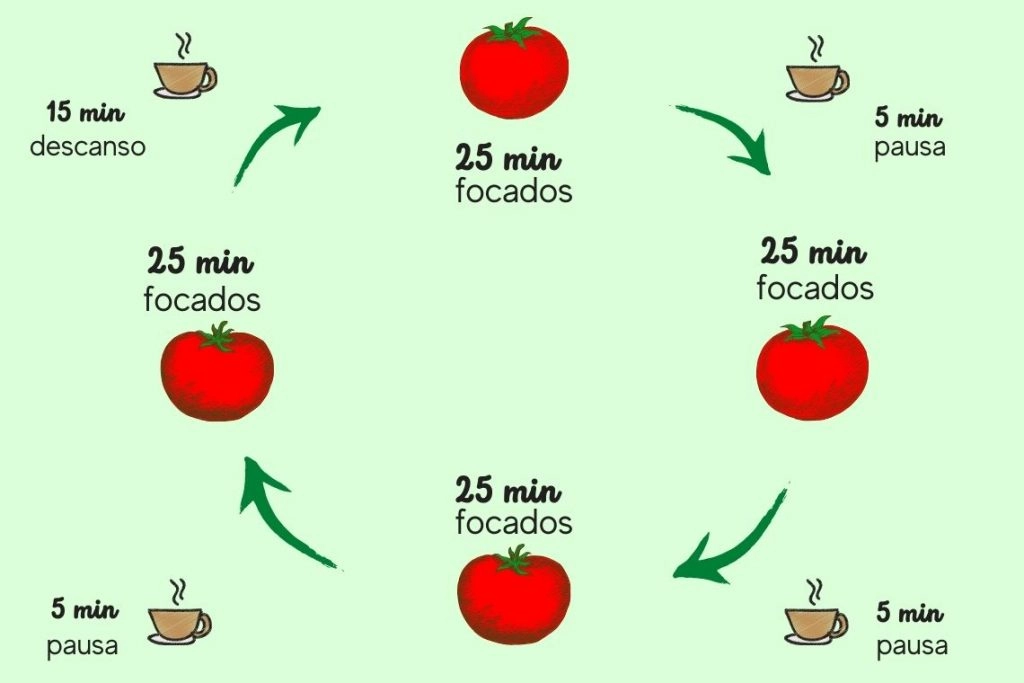
Applications aside, we can manage time and energy using the Pomodoro technique, very popular among students. It consists of creating blocks of working time, alternated by pause blocks, of a shorter time. For example:

Source: NaPrática.org

In working time, we eliminate any kind of distractions. In break time, we move away from the workplace. This work time can be the length of your power unit, using the appropriate amount of blocks for your productive time.

“Work while they sleep,
study while they have fun,
persist while they rest,
and then live what they dream.”

Japanese proverb

Just ask Timothy Ferris.

The 4-Hour Work a Week is the bible for anyone who wants to escape the traditional 9-to-5 (which is never 5; it’s 6 or 7 or 8). Is it possible to work only 4 hours a week? Yes, more or less. The keyword here is productivity. Tim was not well; he was rich, but not well. He wanted more time. He decides to create his own change through four steps:

  1. Definition: introduce the rules and goals of the game.
  2. Elimination: annihilate the absolute notion of time management. This is where the strategy to work 4 hours a day begins (when, in Portugal, the 4-day week is still being discussed).
  3. Automation: outsourcing and non-decision rules. If we can’t control it, we should accept that it hurts less.
  4. Liberation: remote work, mini-retirements and mobility.

Does Tim get on the list of self-help authors? No, yes, maybe… Let’s see:

  • Doing an unimportant thing well does not make it important.
  • The fact that it requires a lot of time does not make a task important.

Freelancers’ time management is based on optimizing tasks (not projects) with the goal of greater productivity. Tim marries the Pareto Principle with Parkinson’s Law:


Pareto Principle

The 80/20 principle, widely used in business. 80% of outputs result from 20% of inputs. Or, 80% of outputs derive from 20% of effort and time. 80% of a company’s profits come from 20% of products and customers.


Parkinson’s Law

Dictates that a task will increase in importance and complexity in relation to the time agreed to its completion. It is the magic of the impending deadline. The pressure of the deadline forces you to focus and complete the task. And because the deadline is so close, you focus on the most important and crucial aspects of the project (who has never left the completion of a job to the deadline?)

Source: Renato Nascimento via Linkedin

Tim Ferris challenges us with the exercise of bringing two seemingly inverse approaches together:

  • Limiting tasks to the important and shortening work time
  • Shorten working time to limit tasks to the important

If you’ve been asked to translate a text and the required delivery date is long, such tasks will weigh down your calendar, whether it’s on a wall or in an app, and the translation won’t be complete until the deadline for delivery. Because as long as the project is open, you will always be editing something, no matter how insignificant. You will use more energy units on tasks of little significance.

Note: the first edition of The 4-Hour Workweek dates back to 2007. Therefore, all the strategies and synergies discussed were not influenced by the 2020 pandemic. I advise you to always read the most recent edition, to find the most up-to-date tips.

“Time asked time
how much time time has.
Time answered time
that time has as much time
as much time as time has.”

When we work as freelancers, time is flexible. We can work more or less hours, but the time is ours. It is within our control, it is within our post-it’s, it is within our little energy boxes.

To be a freelancer is to try to be productive and responsible. We create our own price list (explore this further here) and we choose our clients and projects.

Being a freelancer is also about being visible and looking for work. And looking for work is a very big post-it in a very strong pink. One word is enough: networking.

Being a freelancer requires an ability to establish clear boundaries between personal and professional life. Another post-it? Yes, if you so choose.

Source: Pexels

The keywords of a freelancer are productivity and energy. More than time, because that is a matter of timing.

Back to the initial question of the text: do freelancers need a biometric time clock?

Yes, for self-monitoring and evaluation.

Web design: color trends for 2023

Tendências de Cores
Gabriela Polidoro Lima
UX Designer & Content Writer

With each new year that begins there is always the expectation of what will be the new concepts and trends, whether for fashion, for design, for decoration and even when it comes to consumer behavior.

With the expressive growth of the digital market, the great world forecasts could not be missing when it comes to news and innovations for this area as well.

Therefore, for those who work with the Web universe, stay tuned to the color trends for the year 2023.

Gabriela Polidoro Lima
UX Designer & Content Writer

With each new year that begins there is always the expectation of what will be the new concepts and trends, whether for fashion, for design, for decoration and even when it comes to consumer behavior.

With the expressive growth of the digital market, the great world forecasts could not be missing when it comes to news and innovations for this area as well.

Therefore, for those who work with the Web universe, stay tuned to the color trends for the year 2023.

Color Trends for 2023

Once trends were only directed at Fashion and were dictated by large research companies such as WGSN and Pantone. From the runways to the shop windows, then to the streets, these were the environments where the adherence to the trends dictated each year could be confirmed. Nowadays, and especially after the COVID-19 pandemic, these trends had to be adapted to the digital universe as well, as major brands in the retail and footwear sectors needed to extend their operations into this new habitat. What consumers see in shop windows and runways must be coherent with what they see on the websites and e-commerce of these same brands, so the choice of look and colors cannot just follow trends, but be part of an entire concept and visual language of each brand.

With this change of scenery, it is essential to keep in mind the importance and impact that colors have on a digital project, be it a website, a blog, or an application.

The first reading made by users is done in the first 90 seconds of exposure and 90% of the result of this reading is impacted by color.

So, besides knowing what colors are trending, it is essential to understand how to use them. Let’s get to it?

What is the color of the year for 2023 elected by Pantone?

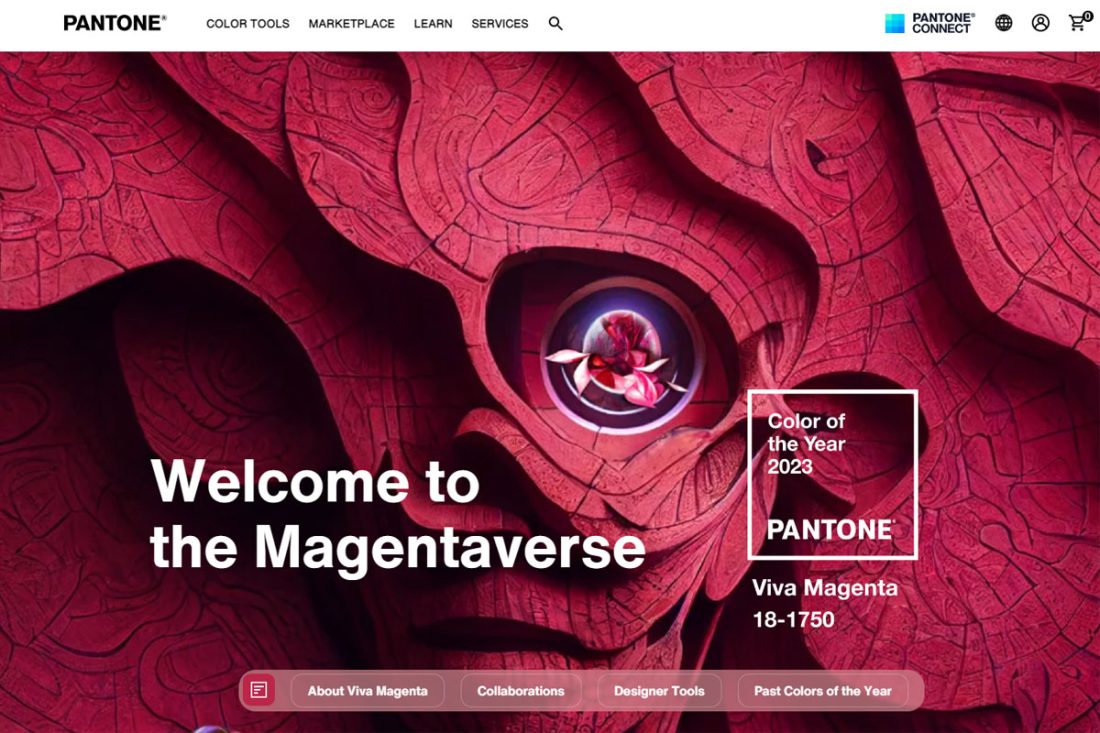
The PANTONE® brand was created by Pantone Inc. based in the USA and considered the world’s color authority for having created, in 1967, a standard language for communication and color management, from the designer to the final consumer. The Viva-Magenta shade is chosen as the color of the year for 2023, which brings with it a matching color palette called Magentaverse – a name that already makes clear the strong influence of the digital universe. On the brand’s official website, the color is described as brave, fearless, and pulsating, whose exuberance promotes joy and an optimistic celebration, writing a new narrative.

According to Leatrice Eiseman, Executive Director of the brand:

“In the age of technology, we seek to design inspired by nature and what is real. PANTONE 18-1750 Viva Magenta, is inspired by the red of the cochineal, one of the most precious dyes belonging to the natural dyes family and also one of the strongest and brightest the world has ever known. The color reconnects us to what really matters, invoking the forces of nature and helping us build our inner strength.”

The website’s homepage welcomes Viva Magenta, the color of 2023, and shows the Magentaverse palette with the color codes chosen by Pantone.

Source: Pantone

Digital Lavender – WGSN’s 2023 Trend Color

The global authority in forecasting consumer trends, WGSN, has also chosen a color to represent the year 2023 and the connection with technology is already explicit in the name: Digital Lavender. Founded in 1998 in West London, the company develops in-depth research that includes data curation, global analysis producing stories and tools needed to understand the public’s behavior.

“Digital Lavender is a gender-inclusive color already established in the youth market and this is expected to expand to all fashion categories by 2023. The synesthetic aspect of this color makes it ideal for self-care rituals, therapeutic practices and wellness products.” Reports the company, which developed the color through Coloro, a system designed for creating and executing color patterns with complete confidence. In addition to dictating fashion and behavioral trends, WGSN also guides the digital market and indicates color “for electronics, digital wellness, quality of life-oriented lighting and housewares.”

With information overload and digitalization on the rise, both companies indicate colors that point to a counter movement, bringing stability and balance. For them, the trend colors of 2023 promise to converge the physical and virtual worlds, connecting users to well-being and bringing strength and mental health.

Source: WGSN

Other colors that WGSN points as a trend for 2023

In addition to the main one, Digital Lavender, WGSN indicates 4 other colors that represent the new moment that the world will live in 2023, after 3 years of imposition and detachment: Astro Dust, Galactic Cobalt, Sage Leaf and Apricot Crush. To watch the video launching the colors and learn more about each one of them, just click here.

Source: WGSN

Before choosing colors, what should be taken into consideration?

Speaking specifically about the digital universe, when choosing the colors that will be used in a project, it is essential to consider some important points:

Understanding

What is the point of applying the most amazing colors of 2023 if the user cannot understand the message that the brand is conveying? Legibility, accessibility and adaptability are the key words to have a good digital performance.

  1. Readability – right level of contrast between background and text;
  2. Accessibility – in addition to colors, it is essential to remember that there are those who simply cannot see the colors and therefore must have access to the voiceover;
  3. Adaptability – night mode, saturation level, and brightness also influence comprehension and demonstrate an important care for users.To know if you are on the right track, there are several tools that allow you to test if the colors you are using provide good readability to users. Here are some sites:
  • https://abc.useallfive.com/ – quickly tests contrasts. Just enter the color codes and it generates the contrast and overlap results.
  • https://colorable.jxnblk.com/ – a tool that can be used to increase the readability of texts with high contrast colors.
    https://
  • www.colororacle.org/ – extension available for Mac and Windows that shows in real time what visually impaired people will see.

Brand Consistency

Following a brand style guide is fundamental to have consistency in communication. As much as the color trend of 2023 is Viva Magenta, you shouldn’t simply change the color of your website or app because of that, knowing that your brand has green as its main color, for example. Using a distinct communication at different communication points can create confusion, frustration, and even convey instability. Imagine a user wondering if they are really on the brand’s official website precisely because, upon entering, they do not immediately see the visual language they are used to seeing? Quick identification is fundamental to generate connection and keep the user active and close.

A good example of communication is the world famous jewelry brand Tiffany & Co, which is already extremely recognized for the use of a very particular shade of blue in its graphic communication, stores, and packaging. The specific shade used by the brand is even now commonly referred to as Tiffany Blue, that is, it has become a globally recognized standard.

The meaning of colors and the sensations they convey

The sensations that colors transmit are much discussed, especially at the end and beginning of a new year. Colors have many meanings, and being aware of these meanings can help a lot when choosing the colors of a digital product.

Colors and the sensations connected to colors:

  • Pink: romanticism, innocence and love.
  • Violet: spirituality, intuition, wisdom, and serenity.
  • Red: joyful color of action, passion, courage, and self-confidence.
  • Orange: joy, success, sympathy, and cooperation.
  • Yellow: creativity, good luck, and communication.
  • Green: energy, hope, regeneration, and nature.
  • Blue: purification, harmony, understanding, and clarity of understanding.
  • White: harmonizes, peace, purity, positivity.
  • Black: independence, dignity, and power of decision.

Source: Tiffany & Co

As we can see in the images above, Tiffany & Co’s website, despite being very clean and clear, to highlight the products it is selling, brings color in a subtle way in order to maintain the visual coherence of its communication.

  • In one image, the home screen of the brand’s official website, brings an information on top of the Homepage with the color in the background, highlighting the message.
  • In the other image, the shadow produced by the jewelry in the highlights images, brings the color almost like a watermark, besides being in the larger image, which highlights the little box where the jewelry is kept.
  • In another screenshot from the same site, even using high contrast colors in the background (yellow and orange), they don’t overlap, on the contrary, they highlight even more the color of the brand in the famous packaging with white lace.

Besides Tiffany & Co, other brands are extremely effective when using their color pattern in different communication points, standing out and captivating consumers. The fast-food chain McDonald’s almost no longer needs to use the entire logo because by combining the two primary colors yellow and red it has created an identity that is recognized anywhere in the world. If one day one of McDonald’s stores changed its colors to green and white, consumers might think they were entering a Starbucks store, another brand that has also created its identity in the combination of colors always standing out in its communication and products.

Beyond these already popular meanings and references, when creating a brand or communicating some message it is always worth considering some factors related to colors and the impact that they have on users. Several studies already conducted on the interference and importance of colors in the digital universe, reveal that it can improve the understanding of a message by up to 73%, the ability to learn by up to 68%, and facilitate reading by up to 40%.

Here are some examples of brands and what the colors they choose convey to their users:

Coca-Colared – transmits joy, vibration and celebration, the main concept of the Apple brand – white or silver – the color transmits technology, innovation and modernity

Fedex – orange – color that conveys speed and cooperation

Facebook – blue – the color conveys trust and transparency

Thus, it is very important to consider what colors convey when choosing which colors to use in your logo, the base of your website homepage, a call to action button, or the icon of your app.

In addition to what you want to convey through color, you should always keep in mind, the brand values and company culture, all of these elements should be in harmony so that, visually, the logo and communication reflect exactly what the company and brand want to say to its customers and consumers.

If you are working with a brand that already has a defined color, you must be careful when combining it with other colors, because they can highlight, contrast, or even overlap the main color, resulting in the opposite of what is desired. Contrasting colors do not always highlight the main color, they can also overshadow or create mental confusion. Combining vibrant colors with more neutral ones always works, as does combining colors from the same palette, choosing different shades of the same color, some lighter and some darker.

The tip is to always choose a main color – or use the brand color – and then combine 1 to 3 extra colors that will compose the visual palette of the project or style guide. This palette should be applied to all communication, whether online or offline.

To help create color palettes, there are some free tools available, such as Color Palette, Cohesive Colors, and 0 to 255.

Besides testing the usability of the chosen color combinations, as already mentioned, it is always valid to create a visual image of the product and test it with the users themselves to know their opinion. Nothing better than to test in practice the efficiency of the chosen color palette.

Read also: How image influences brand success

Design Thinking in business

Pauliny Zito
Planner, copywriter e copydesk

More than a tool, Design Thinking is a critical and creative thinking process to project, plan and design a project.

It is a modern and innovative way of approach that can be used in various contexts and any sector.

Pauliny Zito
Planner, copywriter e copydesk

Trabalhar por conta própria. É isso que define o freelancer, termo em inglês que significa profissional liberal que presta serviços de modo autónomo para empresas ou pessoas, por períodos determinados de tempo.

O trabalho de freelancing oferece flexibilidade, independência e a oportunidade de perseguir a sua paixão.

According to Universidade Nova de Lisboa, Design Thinking:

    – It is person-centered – it starts with deep empathy and knowledge of people’s needs and motivations;

    – It is collaborative – it benefits from diverse points of view and perspectives and is a process in which the creativity of one reinforces the creativity of all;

    – Is optimistic – believes we can all create change – no matter how big the problem, how short the time, or how low the budget.

Although the term “design thinking” had already been used since the 1970s in the United States as a creative approach, in science, engineering, architecture, education, and academic research, it was only in 1991 that Tom and David Kelley and Tim Brown systematized the ideas of Design Thinking into methodology aimed at business management.

The approach only began to gain traction outside the design community after the 2008 Harvard Business Review article [subscription required] entitled Design Thinking by Tim Brown, CEO, and president of the design firm IDEO.

Source: Photo by Alena Darmel

Design Thinking

Design Thinking is a methodology used to create new products, services, processes, or to solve problems. However, a methodology that values creativity, experimentation, and empathy to find innovative, agile, practical, and safe solutions in the business.

The main differential is multidisciplinarity, therefore involving people from different areas of the company.

Source: Photo by Cottonbro

Pillars of Design Thinking

Inspiration

Perceive the problem or opportunity, study the possibilities, the competition, and the behavior of the target audience. Research and gather materials to inspire.


Empathy

Put yourself in other people’s shoes and understand their needs, both the target audience and the company’s internal audience.

Creativity

Having the ability to make connections between the data and distinct opinions collected to find something in common between them.


Then it is necessary to implement the ideas to obtain feedback and learn from inevitable mistakes.


Stages of Design Thinking

Each company has its own organizational culture and particularities and, therefore, must assess the best tools to be used in each stage of Design Thinking and, if necessary, adapt the stages to its reality, to achieve the goal. There are five stages of Design Thinking, namely:


  1. Immersion or Empathy

It is the understanding phase, in which the problem is discussed, the purpose and limits of the project are defined, the SWOT (Strengths, Weaknesses, Opportunities, Threats) analysis is made, as well as exploratory and references research. And then interviews and fieldwork to generate insights.


  1. Definition

This is the stage of analyzing and organizing the material, identifying patterns and categorizing ideas, and synthesizing. Making a graphical representation of this material helps in visualizing the problem. Next, filter the insights, and define the target audience and a line of work.


  1. Ideation 

This is the phase of thinking of a solution to the problem, bearing in mind that no solution is ideal. It is fundamental to use methods to explore the maximum creativity of the people involved, encouraging experimentation and (inevitable) mistakes.


  1. Prototyping

It is the prototyping phase, that is, producing a Minimum Viable Product (MVP). A simple version of the product is made for a test period. 

To create the MVP, answer these three questions:


1) What solution do you offer? What is its real differential? 


2) How does this solution work? What does your product/service deliver that others do not?


3) What is the expected outcome for your customer?


  1. Implementation

This is the phase of implementing the solution. In case the product is validated, make the appropriate adjustments and launch the product or service in the market.

But attention, the work does not end here, taking into account that the company must maintain a process of continuous improvement of each project.

Image: Interaction Design Foundation.

Image: Interaction Design Foundation.

These steps are not always sequential and teams often execute them in parallel, out of order, and repeat them iteratively.

1. Understand the problem;
2. Develop possible solutions;
3. Prototype, test and repeat;
4. Implement.

Source: MIT Management Sloan School

Techniques and Tools of Design Thinking

Design Thinking has a number of collaborative techniques and tools. It is up to the manager to identify those that work best within the context of the project and the company culture.

This article lists and describes 25 techniques and tools of Design Thinking, which I quote below.

In the Immersion stage:

1. Reframe

2. Exploratory Research

3. Desk Research

4. Interviews

5. Awareness Notebooks

6. Generative Sessions

7. A Day in the Life

8. Shadow

In the Definition (or Analysis and Synthesis) stage:

9. Insight Cards

10. Affinity Diagram

11. Conceptual Map

12. Guiding Criteria

13. Personas

14. Empathy Map (knowledge obtained through interviews with clients)

15. User Journey

16. Blueprint

In the Ideation stage:

17. Brainstorming (meeting among people from different areas of the company to think of ideas, present and discuss them, without filters, in a short period of time)

18. Co-creation Workshop (a meeting organized as a series of group activities with the objective of stimulating creativity and collaboration, fostering the creation of innovative solutions)

19. Ideas Menu

20. Positioning Matrix

In the Prototyping stage:

1. Paper Prototype

2. Volume Model

3. Staging

4. Storyboard

5. Service Prototypes

Two other very important tools that are being increasingly used by companies are

Ludification: uses the dynamics and entertainment of games to make a playful activity (can be used at any stage of the process).

Co-creation with the Customer: consists in inviting the customer to participate in the product creation process, either personally or virtually (in the Ideation and Prototyping stages).

How to apply Design Thinking in your company

To apply the Design Thinking methodology in your company, first of all the company culture must make it possible. How to do this?

How about starting by:

  • Providing a comfortable, safe environment that is open to new ideas;
  • Having a multidisciplinary team focused on approaching the public and creating empathy about the solution to the challenge;
  • Adopting data collection and analysis strategies.

Photo by fauxels

Company Totvs followed the Design Thinking method

Totes, which produces software and applications for other companies, used the Design Thinking method to make its products more “friendly” to mobile devices (tablets and smartphones, specifically).

First, the company surveyed to get to know its customers better to understand their current problems and needs.

In the case of retail customers, it identified that these businesses needed simple software that would allow the salesperson to walk the consumer through the shop and make the sale through the device, without having to go through the checkout counter.

After mapping the needs, Totvs organized the ideas on a wall with colored post-its, with the collaboration of employees from different sectors.

Next, it created a prototype of the product, presented it to the client, and listened to their suggestions. Then he made the necessary changes and presented the prototype of the final product.

Once this last version was approved, the company delivered the product ready for use, but not fully finished. Thus, it was possible to observe the client’s experience and make the necessary updates, always promoting continuous improvement.

In this way, Totvs managed, using Design Thinking, to avoid rework and optimize the software production time.

Why should your company invest in Design Thinking?

The manager of a business, nowadays, has to have a great capacity for adaptation, in addition to knowing how to innovate. Design Thinking is a methodology that enables and contributes immensely to this process because from it, it is possible to find quick and effective answers to the most relevant business questions.

The concepts of multidisciplinarity, empathy, and creativity, if well applied, bring great benefits, not only in the scope of projects but also in the company’s daily routine.

They must be part of the organizational culture for a real transformation from the inside out. The organizational culture should be focused on collaboration, cooperation, and encouragement of creativity in all processes.

The cost of implementing Design Thinking is reduced and brings a great competitive advantage to the company.

Moreover, by aggregating employees from all areas, the result is happier professionals, motivated and integrated into the company and with each other, and consequently more productive as well.

Rebranding: How Image Influences Brand Success

Inês Tito
Copywriter

Brands are living entities. They are dynamic. And they are constantly changing. 

A brand’s survival is closely related to its ability to adapt to consumers’ desires.

Inês Tito
Copywriter

Brands are living entities. They are dynamic. And they are constantly changing. 

A brand’s survival is closely related to its ability to adapt to consumers’ desires.

However, to move forward, sometimes an abrupt break from the past is necessary. Such a break can revitalize a brand and make it grow. Or, on the contrary, it can have irreversible consequences. That said, how do you know which way to go?

Instagram’s repositioning is an example of how calculated risk resulted in a successful strategy.

Source: Vecteezy

Brand revitalization through rebranding

Rebranding, or repositioning strategy, is a process used to change the elements that define a brand. However, it does not mean that we are creating a new brand. We are just giving it a “makeover”. The goal is to present consumers with a new identity that they can relate to.

The (right) reasons for rebranding

Changing the brand image can be a tempting idea when there is little consumer engagement or when sales are declining. 

However, before moving forward with a repositioning strategy, it’s important to understand why this is happening. Sometimes it is enough to create a new marketing strategy and present the product from a different perspective.

If, on the other hand, the brand image is outdated or does not reflect the company’s mission and values, perhaps rebranding is the solution. But there are other equally valid reasons:

  • New mission, vision, and values

As a brand evolves, its mission, vision, and values may change. So it is important to review the business model and how it is reflected in the image conveyed to consumers.

  • Mergers and acquisitions

In the business world, acquisitions and mergers between companies are commonplace. However, for the consumer, it can be confusing to differentiate the new brand from pre-existing ones. Therefore, it is important to present the new brand identity through a renewed image.

  • Repositioning in the market

Re-branding can arise from the creation of products and services to reach a new target audience. In this case, although the company’s mission, vision, and values remain unchanged, it is necessary to update the brand image.

  • New markets

When the goal is international expansion, it is natural that new consumers have no relationship with the current brand image. So, to promote brand identification, it may be necessary to change the logo or even the name of the company, or the product.

Rebranding Strategies

The success of a repositioning plan depends on a thorough market study. Without knowing our target audience, our competitors, and the perception of the brand among consumers, how can we define the next steps?

In addition, it is necessary to evaluate the brand’s mission, vision, and values. Are they aligned with the message the brand wants to convey?

Once these aspects are clarified, it’s time to make decisions.

Rebranding total

Total repositioning results in a complete change of the brand image, which may include the company’s mission and values. 

In this strategy, it is common to create a new logo. In addition, the brand name, slogan, color scheme, and the font may be changed. The result is an image distinct from the original. 

With this strategy, the brand identity is put to the test. 

In the case of established brands, this approach can do irreparable damage. Loyal consumers may find it difficult to associate the brand with the product, and for investors, this means heavy losses. Ultimately, all that remains is to reverse the whole process and return to the original image.

Rebranding partial

Through partial repositioning small adjustments are made to the brand image. In many cases, it is only necessary to change the logo and keep the original color scheme. In others, the image remains the same. What changes is the voice of the brand

This strategy is used by mature brands that just want to renew their image and retain loyal customers. In this way, the consumer recognizes the brand and its products through an improved image.

Instagram: The success of a risky rebranding 

The first revolution instituted by Instagram was its appearance. 

The second was the 2016 rebranding.

Source: Unsplash

In 2010, the social network Instagram was surprised due to its innovative concept: a platform dedicated to visual content, created from mobile devices. Quickly, anyone anywhere could post and share photos with friends and family.

This simple idea turned into a recipe for success. Six years later, Instagram had 400 million users. By this time, it was clear that the social network had grown enough that it was necessary to review brand communication.

The need for change

Usually, repositioning processes arise to solve a problem. 

In the case of Instagram, the “problem” is the dream scenario for any executive: a brand that has naturally grown beyond its own identity. This kind of growth forces a review of the brand’s image to keep up to date and keep up with its evolution.

The purpose of Instagram users has changed since the appearance of the platform. In 2010, the app was primarily used to share photos with friends. However, in 2016, companies were expanding their business by placing ads on the platform.

During this period, the social network has invested in several services to keep up with users’ needs. Among them are direct messages, videos, ads, or tools for businesses, such as newsletter subscriptions and product purchases.

In addition, Instagram bet on improving the user experience. It developed a simpler and more intuitive interface, focused on creating and publishing content.

In this sense, a logo inspired by a Polaroid camera, which takes us back to the nostalgia of the 80s, will hardly be associated with the latest generation social network.

The transformation of an icon

Instagram’s first logo was developed by Kevin Systrom, the co-founder of the social network. Inspired by the Polaroid camera from the 80s, it is intended to remember childhood and family moments. 

Considering that Instagram’s initial goal was to make it easier to share photos with friends and family, this logo couldn’t be more appropriate. For this reason, in the following years, the small icon was adjusted, to present an updated version of the camera, without forgetting its origins.

Source: 1000logos

So when the new logo was announced in 2016, the reactions were quick to follow. If on the one hand, some loved the new image, on the other were users loyal to the original image. 

Instagram simplified the old camera image through a minimalist design. In addition, the white outline of the camera’s diaphragm contrasts with the rainbow-inspired warm color gradient of the original image. 

The interface has also been updated to black and white tones. For Ian Spalter, the person in charge of Instagram’s rebranding, the icon would serve as a “colorful gateway” to an application where “colors should emerge from the content posted by users.”

This drastic change has generated great debate in the online world. Whether it was good or bad comments, the controversy fueled the popularity of the app. So, despite initial resistance, the change proved to be a success. In 2018, Instagram registered one billion new users worldwide.

The uniqueness of Instagram’s rebranding

Modern society lives at a faster pace than previous generations. As a consequence, we focus our attention on what is perceptible faster. We have no time to waste and want to quickly perceive what our senses detect.

For this reason, the latest trends in graphic design have common elements that aim to make brands easier to recognize. However, when it comes to Instagram’s rebranding, some features are unique.

For this reason, the latest trends in graphic design have common elements that aim to make brands easier to recognize. However, when it comes to Instagram’s rebranding, some features are unique.

  • Simplicity

In short, the sooner the consumer understands what an image is about, the sooner he or she will associate it with the brand. So, in the logic of “less is more”, the new Instagram logo represents in a simplified way the key elements of the brand identity: photo and video sharing.

  • Relevance

For a repositioning strategy to be successful, the logo must be relevant to the target audience. That is, it informs the audience what that image is about. The color gradient and clear layout of the Instagram logo reveal a brand with a friendly personality, where the image, whether in photo or video, is the main element.

  • Memorable

Despite numerous studies conducted on human memory, in many ways it remains a mystery to researchers. However, one thing is certain: our brain simplifies complex information to retain and create memories. 

For a repositioning strategy, this means that an image with little visual detail promotes brand recognition.

This was Instagram’s bet. By presenting a clean and simple logo, the social network leaves its impression on the user’s memory. At the same time, it can communicate the most important aspects of the brand’s personality.

  • Timeless

In a rebranding process, it is important to think long-term, avoiding just following the latest design trends. With this strategy, the brand can define which way to go and leave a door open for the future.

Instagram has achieved the goal of timelessness perfectly. Since its inception, the social network has changed its focus on photography to include video as well. Thus, the new image suggests the versatility of the brand, regardless of which path to take.

In 2022, Instagram continues to reinvent itself. The new algorithm has brought changes to the presentation of content, with a greater focus on video content. As a result, the platform updated the color gradient, created a custom font, and developed a new format to celebrate creativity and self-expression.

What can we learn from Instagram’s rebranding?

Change is the essential element of any rebranding strategy. Change is part of the continuous improvement process that allows brands to evolve. 

Instagram decided to take a risk and change the image that the world was already familiar with. However, it was a calculated risk, supported by thorough research and testing. So what can we learn from this rebranding?

Knowing the brand’s impact on users and thinking about a long-term market strategy is important to present a timeless new image that is well accepted by the public. For a year, the platform researched and analyzed the data collected before applying such a drastic change.

In addition, it is essential to test the new identity with employees and consumers. By surveying test groups, Instagram obtained vital information that led the rebranding team to the final version of the new brand image.

Finally, it is important to accept that it is impossible to please everyone. Change creates anxiety and resistance to what is new. However, it is essential to move forward. This principle underpinned Instagram’s rebranding process, which acknowledged the negative comments and nevertheless did not stop gathering feedback.

Instagram’s rebranding demonstrates the importance of maintaining a brand image tailored to user needs. What started as a shocking change has turned into a success. Considering the platform’s evolving pattern, Instagram may surprise us more and more in the future.

Freelancer: utopia or a possible dream job?

Pauliny Zito
Planner, copywriter and copydesk

Working for yourself. That’s what defines freelancing, a term meaning a freelancer who provides services independently for companies or individuals for set periods.

Freelancing offers flexibility, independence, and the opportunity to pursue your passion.

Pauliny Zito
Planner, copywriter and copydesk

Working for yourself. That’s what defines freelancing, a term meaning a freelancer who provides services independently for companies or individuals for set periods.

Freelancing offers flexibility, independence, and the opportunity to pursue your passion.

In the words of Peggy De Lange, VP of International Expansion at Fiverr, a platform that connects businesses to freelancers:

“The pandemic has caused people to look for alternative ways to ply their trade. For those who were used to working in a more traditional format, the forced adhesion to the home office ended up working as an experience that showed that it is possible to unite flexibility and productivity. Naturally, professionals want to keep the most positive aspects of this experience from now on, which ends up contributing for many to move towards the freelance market”.

Souce: Andrea Piacquadio, Pexels

Freelancer Skills

The freelancer must have good verbal and written communication, a high capacity for time management and planning, high commitment, and, above all, be very organized and have the discipline to prioritize activities and meet deadlines.

Focusing on problem-solving is one of the secrets to being successful in the areas of discipline and balance. To do so, the first step is to know what exactly you have to solve. 

Other necessary skills are adaptability and empathy because to be able to solve the clients’ problems, first of all, it is necessary to understand them. And to understand them well, you have to put yourself in their shoes.

The freelancer must be able to establish clear boundaries between professional and personal life and be careful not to be influenced by the many distractions present at home.

Being a freelancer implies being your boss, a challenge that requires the professional to develop leadership. First, of oneself. Then, in the freelancer and client relationship, leadership is present in creating trust and credibility. For freelancers working with partners, leadership should be exercised with cordiality and security, while giving them autonomy. Finally, there is also the leadership relationship with family and friends, so that they perceive the seriousness of your work and respect schedules and limits. 

Last but not least, the freelancer must know how to promote their work, building their strong personal brand, which will only be achieved if the professional is a specialist in a certain niche – and not a generalist. 

How to build a strong personal brand? By having a good Networking strategy.

  • Have and nurture a wide list of contacts to get good opportunities, bearing in mind that it is not enough to gather contacts; you have to keep them “alive”;
  • Participate in events in the same sector as yours;
  • Being present and active in employment groups;
  • Subscribe to freelancing platforms and connect with other freelancers;
  • Participate in discussions and be present on social media, especially LinkedIn, posting frequently and interacting with potential clients;
  • Having a website/portfolio that is always up to date and posting it constantly;
  • Build a name in the market, becoming a reference in your area as a freelancer;
  • Maintain a good relationship with your clients, based on trust;
  • Keep yourself always contactable and available.

Benefits of being a freelancer

While freelance work is better in terms of flexibility and purpose, traditional, contract jobs, for example, offer better benefits and financial stability.

Working as a freelancer offers professionals the opportunity to be in control of their careers, which cannot be achieved through traditional employment.

Being able to work remotely, having the flexibility to spend more time with your family, living your desired lifestyle, looking after your physical and mental health, and also controlling your earning potential are some of the key benefits of being a freelancer.

Source: Fauxels, Pexels

Tip: do some financial planning. Considering that a freelancer’s monthly salary is variable, good financial planning is to keep in mind how much money you have, how much you will receive, and how much and how you are spending it. Only then you can make assertive decisions and not spend more than you can afford.

10 myths of the freelance career

1. Freelancer sets the extra budget

The professional may even use the freelance work as an extra, but nothing prevents him from making it his main remuneration.

2. The freelancer earns little

Specialists in their fields of expertise who work as freelancers no longer have their hourly rate determined by a company and set their price, usually charging above average.

3. Freelancing is for those who are entering the job market

Although it is a very attractive area for young people at the beginning of their career, who are driven by novelty and seek more freedom and flexibility, it is not an area exclusive to this public.

4. No need to work in a team

This is because, even if the freelancer does not meet the company’s team, there is always interaction and collaboration between both, from the receipt and understanding of the briefing to the execution within the predetermined deadline.

5. Few working hours per day

The number of working hours of the freelancer depends on several factors, and may sometimes even be higher than the standard workload of companies, namely: number of clients and jobs, degree of difficulty and complexity of each job, capacity, and pace of production, and concentration of the freelancer, among others. As the freelancer does not have a workload to comply with, he establishes how many hours he should work according to his needs and deadlines.

6. Freelancer spends the day working in pajamas on the sofa

The freelancer can wear what he feels like and work wherever he wants, whether at home, in coworking spaces, or even in public places like parks, cafes, and libraries. Each person has a way of being and behaving, which doesn’t make pajamas or the sofa a rule. 

7. Always available

A freelance career is not synonymous with an emptier schedule. Every freelancer has a personal work dynamic and therefore organizes their demands based on the time to perform each task.

8. You don’t have to prospect for clients

Quite the opposite. As stated earlier in this article, freelancers must disseminate their work continuously, using digital tools, to stand out in the market.

9. It is not possible to live as a full-time freelancer

Nothing is impossible. If you have the necessary skills and competencies, focus, organization, and know how to promote your work, clients and jobs will always come your way.

10. Anyone can be a freelancer

Not everyone can be a freelancer pure and simple because not everyone adapts to freelance work. Some people prefer to work for a single company, doing their job eight hours a day, 40 hours a week, getting a fixed salary with a contract, and that’s fine. That’s because to be a freelancer is to have no fixed income, it’s to have to do your bookkeeping and be responsible for your taxes and social contributions. And also to have no periodic paid holidays or Christmas bonuses.

The freelancers Market 

The freelance market is hotter than ever. In the last two years, especially with the pandemic of COVID-19, we have experienced a revolution in the global labor market, with mass layoffs and consequently the rise of freelance or independent work, temporary, remote, digital nomads, and autonomous.

It is indeed a growing career, which was already a working trend as published in a Forbes article from August 2018.

In Portugal, in the last two quarters of 2021, according to the National Institute of Statistics, the number of self-employed (freelancers) and the professionals known as ENI – Entrepreneur in Individual Name reached 733,000, the highest figure ever in Portugal, and which is equivalent to about 15% of the active population in the country.

Most common types of jobs for Freelancers in Portugal

The most common types of work for freelancers in Portugal are freelance and service-related jobs, namely:

  • Designers;
  • Journalists;
  • Advertising and Marketing professionals;
  • Programmers and website developers;
  • Producers or Creators of audiovisual content;
  • Photographers;
  • Translators;
  • Proofreaders;
  • Business consultants;
  • Personal trainers;
  • Physiotherapists;
  • Beauticians who provide home care services;
  • Language teachers and others who give private lessons.

8 useful apps for Freelancers and Entrepreneurs to manage their business

Source: Canva Studio, Pexels

Freelancer’s Tax and Social Security obligations in Portugal

To work as a freelancer in Portugal, it is necessary to open an individual activity, in person at the Finance counter or through the Portal das Finança and have:

  • Identification: Citizen Card or Residence Card/Title;
  • NIF – Tax Identification Number;
  • IBAN in your name.

In the form, you should select the CAE of your professional activity (classified according to the Portuguese Classification of Economic Activities by Branches of Activity) or CIRS (which consists of activities of service providers) and fill in a forecast of your annual income for IRS purposes (if it is more than 12.500€ such income will be subject to withholding).

Please note: if the activity starts in July, for example, you should calculate the forecast based on 6 months, that is, from July to December, because the system will then automatically calculate the value for 12 months.

Once the declaration of the beginning of activity is submitted and approved, the freelancer can start issuing Invoices, Receipts, or Invoice-Receipts (Green Receipts) through the Portal das Finanças.

Freedom of choice 

Freelancing intensifies and proves that intellectual capital can be available anywhere on the planet.

Source: Cottonbro, Pexels

IVA: if the annual calculation is greater than 12,500 euros, it is compulsory to be included in the normal IVA regime, with the corresponding payment and deduction of IVA and submission of the periodic IVA declaration.

If the annual calculation is less than 12,500 euros, the framework is in the exemption regime, without the need to pay VAT or submit the periodic VAT declaration.

Social Security: in the first year the freelancer is exempt from payment. After 12 months, the contribution is calculated based on the income of the 3 months before the declaration and made in January, April, July, and October (i.e. the freelancer must submit a declaration 4 times a year, in addition to the annual declaration).

IRS withholding: If you have received less than 12,500 in the previous year, you do not need to make the withholding tax, and the IRS will be settled when you make the annual declaration. However, if you received more than 12.500€, you are obliged to withhold tax at the source every month.

How to calculate the hour value of freelancer work

The InvoiceXpress blog provides a tool that can help you calculate the hourly rate for freelance work:  Calculadora Valor Hora para Freelancers | Invoicexpress.

MeuSalario.pt provides a formula to calculate the hourly rate:

  • Living Wage = Cost of Living + Cost of Occupation + Tax Expenditure
  • Working Days = (Working Days – Vacation Days – Sick Days)*(working hours per day)

Hourly rate = Living Wage / Working Hours

Example: If your gross salary is EUR 1,600 per month and you expect to work 48 weeks, a total of 240 days, 7 hours a day, you should

  • Calculate the annual salary for 12 months = 19,200 euros
  • Calculate the working hours per year = 1,680 hours
  • Divide the annual salary (19,200 euros) by the number of working hours (1,680) = 11.42 euros

Freedom of choice

The freelancing modality intensifies and proves that intellectual capital can be available anywhere on the planet.

This model without employment ties, previously less valued, better meets the aspirations of independence and autonomy of the new generations – but not only – of professionals entering the labor market. 

Thus, it is possible to experiment with working with different types of companies and respective cultures, selecting jobs that are more convenient and which make more sense to be developed, from the freelancer’s point of view. 

Source: Andrea Piacquadio, Pexels

What Freelancers want

To have more job satisfaction. That’s what freelance professionals want most. 

The Fiverr platform survey, conducted Censuswide between November 16 and 24, 2020, in which 1,051 professionals who worked remotely that year in different countries were interviewed, found that of the freelancers interviewed, 76% agreed that working from home allowed them to take on more work in parallel. In addition, 68% said that working from home made them more productive, which also allowed them to take on other work.

Be a freelancer

To work as a freelancer, takes dedication and hard work, above all having an open mind and being willing to take on new challenges.

In a highly competitive market like this, defining a niche makes a lot of difference. The more you specialize in a certain area, the better because technical knowledge is synonymous with high quality in the delivery of work.

If you are talented and want to enter the freelance market, join the largest talent network at Scallent, a subsidiary of Jelly – Digital Agency, where your work is truly valued and dignified.

Escallent selects Top Talent within an Agency’s areas of competence and connects them to client projects, in a curated, agile and competitive model.